
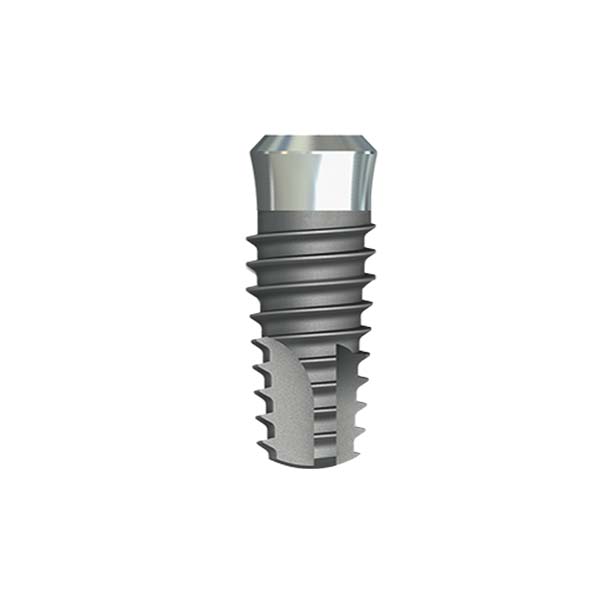
Nta Tissue Level
NTA Tissue Level Implant features SLA surface technology for optimal osseointegration, 1.5° taper design for high primary stability, and a conical connection for bacterial sealing and abutment screw security. With a no-mount system and machined surface cuff for soft-tissue affinity and plaque control, it ensures long-term biomechanical and clinical success.
NTA Tissue Level Implant — Surface Treatment “SLA”
The SLA surface is produced by a large grit sand-blasting process with corundum particles that leads to a macro roughness on the titanium surface. This is followed by a strong acid-etching bath with a HCl at elevated temperature for several minutes. This produces the fine 2–4 μm micro pits superimposed on the rough-blasted surface. The surface is not micro porous and therefore provides no enclosed volumes to reduce vulnerability to bacteria. The chemical composition of the SLA structure was found to be titanium dioxide (TiO2) using X-ray photoelectron spectroscopy.
This method analyses the first few atomic layers of the surface, and thus the chemical composition of the material which is in direct contact and interacts with tissue fluids and cells.
Taper Degree 1.5°
The double-thread screw design with a 0.8 mm pitch and 0.45 mm thread depth offers self-threading capability, allowing easy placement during surgery and providing high primary stability. The 1.5° taper angle ensures secure stability even in soft bone structures.
No-Mount System
Surgery time has been shortened by removing the fixture mount from the package and using a fixture driver for which the mount is not necessary. However, fixture mount can be provided separately according to the preference of the clinicians.
Conical Connection
Our product has a conical connection that provides bacterial sealing, eliminating micro-movement and micro-leakage issues. In this way, bone structure is preserved and the loosening of the abutment screw is prevented. The inner octagonal index ensures right and precise placement of the abutment.
Straight Body
As implant length gets longer, the straight body gets longer. For this reason, long implants can be placed steadily without causing unexpected changes at the time of surgery, same as straight type implants.
Cutting Edge
When using the drills that contain three sharp edges, the preparation of the implant osteotomy is easy, the frictional heat formation is low, postoperative pain is limited and the drilling time is quite short.
Root Form
Root form of the implant ensures easier placement, high initial stability, superior stress distribution, less risk of damaging neighboring roots and low risk for accidental perforation of concave surfaces.