
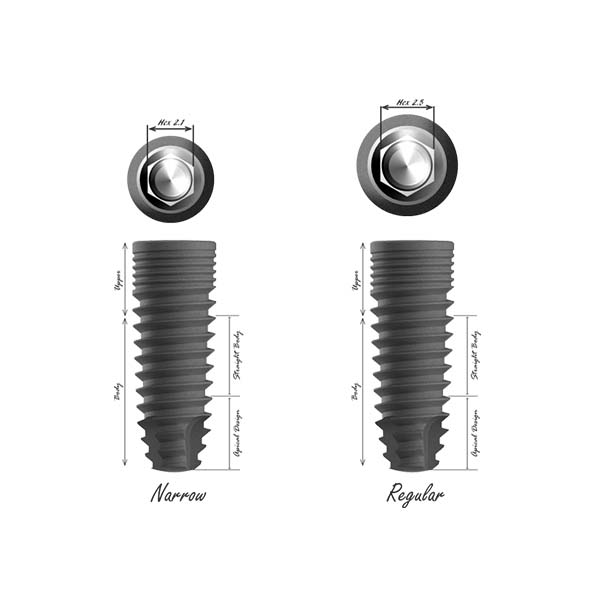
Nta Spure Fixture
NTA Spure Implant features SLA surface technology for optimal osseointegration, platform switching for crestal bone preservation, conical connection for bacterial sealing, and a no-mount system for faster surgery. Available in Narrow and Regular platforms with maximum primary stability and long-term biomechanical performance.
NTA Spure Implant — Surface Treatment “SLA”
The SLA surface is produced by a large grit sand-blasting process with corundum particles that leads to a macro roughness on the titanium surface. This is followed by a strong acid-etching bath with HCl at elevated temperature for several minutes, resulting in fine 2–4 μm micro pits superimposed on the rough-blasted surface. Since the surface is not micro-porous, it provides no enclosed volumes and therefore reduces vulnerability to bacterial contamination.
X-ray photoelectron spectroscopy has identified the chemical composition of the SLA surface as titanium dioxide (TiO2). This analytic method examines the first atomic layers of the material, ensuring biocompatibility at the exact points where tissue fluids and cells come into direct contact.
Platform Switching
Implant–abutment junction is positioned closer to the center of the implant and away from the implant–bone interface. In combination with the conical connection, crestal bone loss is rarely observed in NTA Spure implants.
No-Mount System
Surgery time is reduced by eliminating the fixture mount and instead using a fixture driver with highly durable separation/connection capability. Fixture mount can be supplied separately upon clinician request.
Conical Connection
The conical connection provides bacterial sealing, preventing micro-movement and micro-leakage. This supports crestal bone preservation and prevents loosening of the abutment screw. The inner hex index ensures precise abutment seating.
Straight Body
Longer implant lengths correspond to a longer straight body section, enabling stable and controlled placement in deep applications without unexpected deviations during surgery.
Cutting Edge
Triple-sharp drill architecture allows fast and comfortable osteotomy preparation with reduced heat generation, shorter drilling time and minimal postoperative discomfort.
Root Form
Root-shaped macro design ensures easier positioning, high primary stability, balanced load distribution and decreased risk of sinus/perforation complications.
Narrow Platform (2.1)
Suitable for limited bone width and aesthetic zone applications while maintaining high stability and prosthetic accuracy.
Regular Platform (2.5)
Ideal for posterior zone and full-arch restorations, providing superior long-term biomechanical support under high occlusal loading.